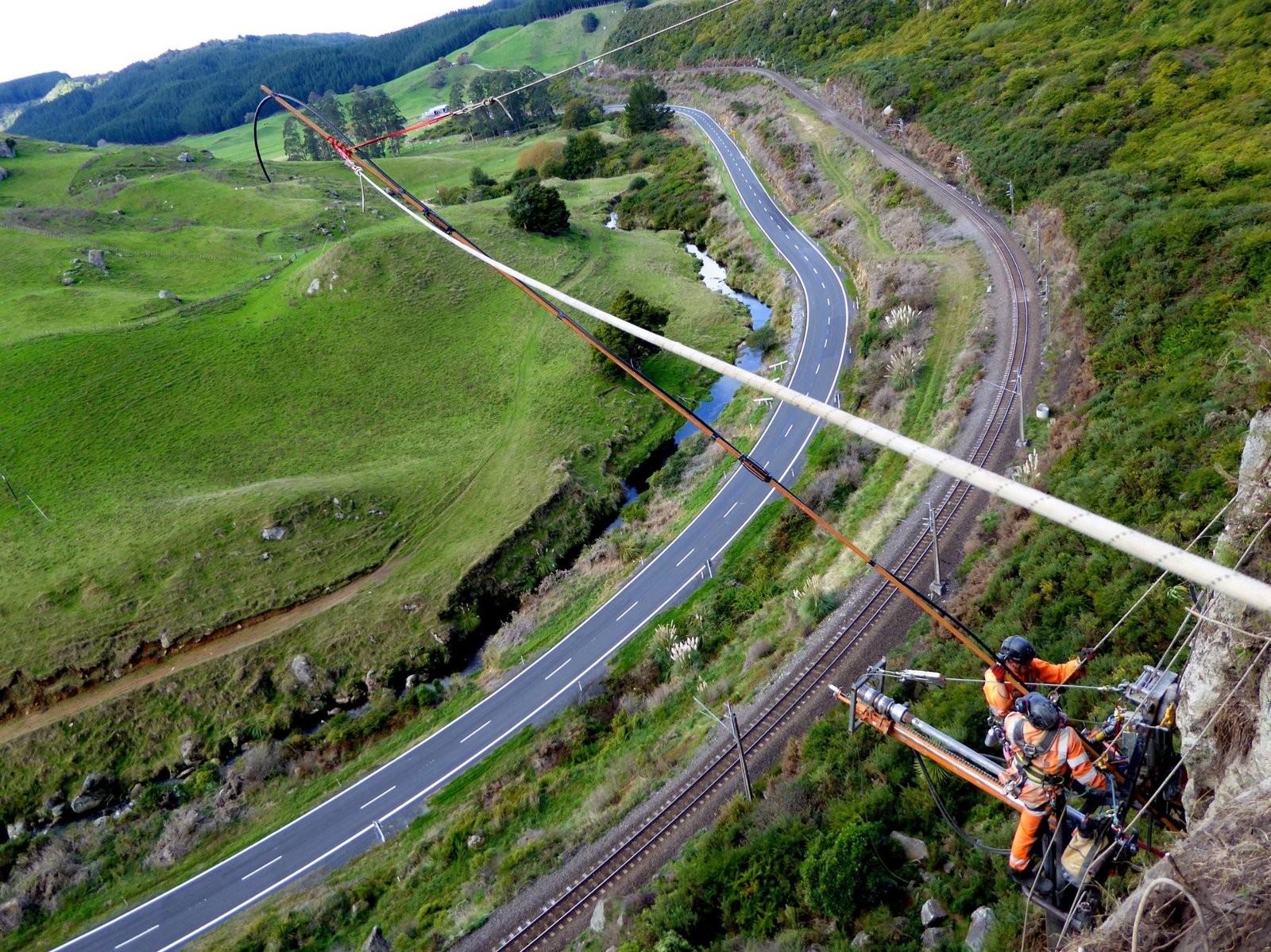
Grout sock product details.

A manufactured sleeve for civil engineering applications in tunnelling and ground stabilisation, used in conjunction with rock anchors.

Installation.
Installation.Rock-anchor application environment
Product overview

Tubular fabric for grout retention.

A tubular fabric to aid grout retention in a range of widths and available in single and double thickness. Rolls are available in approximate 50 metres in length with an allowance for one join.

  • Available in single and double thickness
  • Widths from Grippa 7cm to Grippa 12cm
  • Rolls available in approximate 50 metres in length
  • Allowance for one join
Core product benefits

Contain more. Waste less.

Limit grout seepage

Helps prevent unnecessary grout migration into the surrounding ground.

Use material more efficiently

Supports a more controlled use of grout on suitable rock-anchor applications.

Environmental advantage

Reducing seepage and wasted material can lessen the environmental impact of grouting.

Sizes and lengths available

Single and double knit product schedule.

A tubular fabric to aid grout retention in a range of widths and available in single and double thickness. Rolls are available in approximate 50 metres in length with an allowance for one join.

Product configurationSizeApprox lay flat widthRoll length / notes
Single KnitGrippa 7cm7cmApproximate 50 metre roll with an allowance for one join.
Single KnitGrippa 8cm8cmApproximate 50 metre roll with an allowance for one join.
Single KnitGrippa 9cm9cmApproximate 50 metre roll with an allowance for one join.
Single KnitGrippa 10cm10cmApproximate 50 metre roll with an allowance for one join.
Single KnitGrippa 12cm12cmApproximate 50 metre roll with an allowance for one join.
Double KnitGrippa 7cm7cmApproximate 50 metre roll with an allowance for one join.
Double KnitGrippa 8cm8cmApproximate 50 metre roll with an allowance for one join.
Double KnitGrippa 9cm9cmApproximate 50 metre roll with an allowance for one join.
Double KnitGrippa 10cm10cmApproximate 50 metre roll with an allowance for one join.
Double KnitGrippa 12cm12cmApproximate 50 metre roll with an allowance for one join.

Rolls are available in approximate 50 metres in length with an allowance for one join.

Laboratory test information

Technical Specification Summary.

GROUTGRIPPA GROUTSOCK FABRIC
Important testing note

Please note information below is the result of lab based testing and any conclusions are deduced from these tests. Users must satisfy themselves regarding the suitability of this material for each individual project

01

Product Configurations

Single Fabric (S)12cm layflat tested
Double Fabric (D)12cm layflat tested
02

Applicable Test Standards & Equipment

Moisture TestingGATS (Gravimetric Absorbency Testing System), 600 s saturation, 1396 Pa load
Air PermeabilityASTM D737
Thickness Under LoadZwick/Roell 2.5 kN (Compression Mode)
Tensile PropertiesDIN EN ISO 13934-2 (Grab Method), 50 mm/min
Elastic Recovery & Force DecayDIN EN 14704-1, 60 s hold, Gauge Length 100 mm
03

Moisture Absorption & Transfer (600 s Saturation)

  • S – Dry Mass: 1.0208 g
  • S – Absolute Capacity: 2.2324 g H2O
  • S – Normalised Capacity: 2.1886 g H2O/g
  • S – Absorption Rate (5–80%): 0.00380 g/s
  • D – Dry Mass: 2.0918 g
  • D – Absolute Capacity: 3.421 g H2O
  • D – Normalised Capacity: 1.6366 g H2O/g
  • D – Absorption Rate (5–80%): 0.00542 g/s
Conclusion

Single fabric is more efficient at absorbing liquid with minimal material. Double fabric is better at holding a larger volume of liquid

04

Air Permeability (ASTM D737)

  • S – 2926 ± 30.72 mm/s
  • D – 1266 ± 18.55 mm/s
  • Reduction (D vs S): ~57%
Conclusion

Single fabric has higher air permeability and will generally support faster curing although care should be taken that rapid drying does not cause surface cracking. Double fabric promotes a slower moisture release.

05

Thickness Under Load (Circular Sample Ø120 mm)

  • Applied Pressures: 2 kPa (22.62 N), 20 kPa (226.2 N), 80 kPa (900 N)
  • S – 2 kPa: 0.83 ± 0.005 mm
  • S – 20 kPa: 0.42 ± 0.01 mm
  • S – 80 kPa: 0.03 ± 0.006 mm
  • D – 2 kPa: 1.18 ± 0.009 mm
  • D – 20 kPa: 0.8 ± 0.006 mm
  • D – 80 kPa: 0.38 ± 0.006 mm
Conclusion

Single fabric may be beneficial where a low profile installation is required Double fabric retains bulk under load and provides cushioning and load distribution.

06

Tensile Properties (DIN EN ISO 13934-2)

  • S – MD: 43.80 ± 2.20 N | Elongation: 196.48 ± 10.28%
  • S – CMD: 334.72 ± 7.02 N | Elongation: 68.47 ± 6.04%
  • D – MD: 54.74 ± 5.11 N | Elongation: 230.50 ± 24.09%
  • D – CMD: 572.41 ± 11.84 N | Elongation: 74.15 ± 7.72%
Conclusion

Single fabric conforms easily to irregular shapes and absorbs movement and can be beneficial for installation processes where movement , vibration or deformation is expected . Single fabric is not intended for high load bearing applications. Double fills this role with it’s strength and dimensional stability

07

Elastic Recovery & Force Decay (DIN EN 14704-1)

  • Strain Levels: MD 100% | CMD 20%
  • Force Decay (MD): S ≈5–6% | D ≈5–6%
  • Force Decay (CMD): S ≈15–16% | D ≈11–15%
  • Permanent Elongation (All Samples): 0%
  • Recovered Elongation (D): 100%
  • Elastic Recovery (R): MD ≈100% | CMD ≈500%
08
Technical Performance Summary

Key findings from the supplied test summary

D provides higher absolute moisture absorption and tensile strength.

S provides higher mass-normalised absorption efficiency.

D significantly improves thickness retention and load-bearing capacity.

Both configurations exhibit complete elastic recovery within tested strain limits.

Groutgrippa A Division Of Easigrip Ltd.1 Whitchurch Business Park, Shakespeare Way, Whitchurch, SY13 1LJ United Kingdom
www.groutgrippa.co.uk